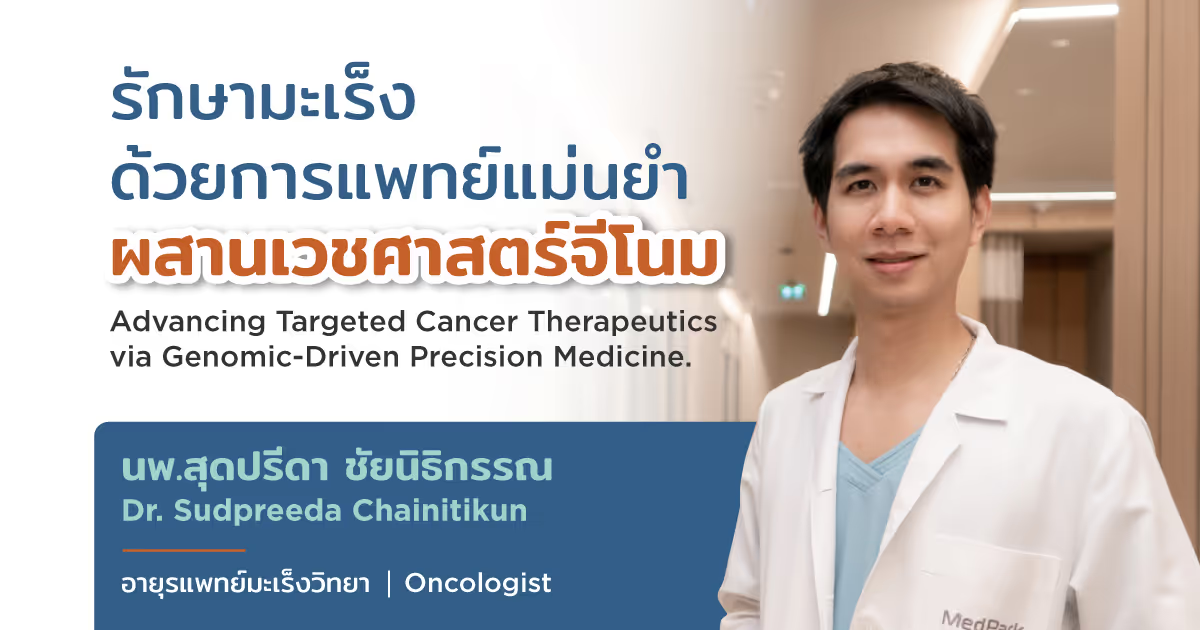





Precision Medicine Cancer Treatment with Genomic Integration
Cancer treatment today offers higher hope, greater opportunity, and more promising possibilities than ever before. Imagine how much better it would be if cancer treatment could be more precise with targeted therapies that provide the best possible results for each specific cancer. This approach reduces waiting times, eliminates the inherent costs associated with "trial and error" treatments, and significantly increases the chances of success.
Currently, Genomic Medicine plays a vital role in supporting cancer treatment, helping to turn the impossible into the possible. Dr. Dai – Dr. Sudpreeda Chainitikun, a specialist in Medical Oncology, provides an update on these rapidly advancing breakthroughs in cancer care.
Genomic Medicine and Modern Healthcare
In cancer treatment, genomic medicine can disclose the genetic precursors (molecular building blocks) before they mutate into cancer. This advanced discipline also plays a crucial role in supporting the diagnosis and treatment of numerous other medical conditions.
“Hyperlipidemia, for instance, is heritable. Genetic testing enables us to identify the root cause, whether a patient carries a genetic variant that prevents the body from producing key protein receptors required for hepatic cell engulfing of circulating LDL particles. In such families, elevated cholesterol levels may persist across generations.” Dr. Dai illustrated this point.
Similarly, cancer is due to genetic abnormalities, causing proliferative cell control to become defective. These mutations grant the cells a form of 'immortality,' allowing them to divide continuously without dying. In contrast, normal cells form, divide, and eventually reach a point where they stop dividing and perish. That is why cancer cells grow unchecked, invading and disrupting normal cells and various bodily functions. Genomic medicine enables us to analyze these genetic mutations in detail and to design far more effective, precisely targeted treatment strategies than ever before.
Matching Cancer with Targeted Therapy by Genetic Testing
Beyond standard genetic profiling of tumors, advanced analysis of specific cellular mutations now enables doctors to select targeted therapies with far greater precision. Targeted therapy represents one of the most effective strategies in oncology. When a targeted drug matches a cancer molecular profile, it can be a bona fide game changer.
“Genomic medicine allows us to identify the specific mutations that drive cancer growth. Because cancer cells harboring these mutations do not undergo normal cell death.”
“Once we understand the root cause, we can select targeted therapies to inhibit abnormal proteins or to halt the proliferation of cancer DNAs, enabling treatment to become far more effective and specific.”
More Comprehensive Testing with Significantly Shorter Turnaround Time
In the past, testing for genetic mutations was limited to analyzing one gene at a time. In many instances, the detected mutation was not the real driver of the disease, or the available drug proved ineffective against that specific mutation. Doctors had to test additional mutated genes individually, a process that was inefficient and time-consuming, as a single cancer may contain hundreds of mutations.
Today, advanced technologies have dramatically shortened testing time—from several weeks to just a few days or up to two weeks. It is made possible by testing technology that can analyze multiple genes simultaneously and provide far more comprehensive mutation profiling, including the detection of rare genetic alterations. This technology is known as Next Generation Sequencing (NGS), a state-of-the-art genomic sequencing platform capable of deciphering large volumes of genetic sequences in parallel. As a result, testing time is significantly shorter, and doctors can identify clinically relevant mutations more precisely, matching with the most appropriate targeted therapies.
“In lung cancer, for example, many Asian patients develop the disease due to genetic mutations triggered by PM2.5 air pollution rather than smoking. These cancers have distinct genetic profiles that require different targeted therapies. If we test for only a single mutation and find nothing, we may overlook other co-existing mutations. In such cases, we might miss the opportunity to promptly prescribe the most effective treatment tailored to the true underlying genetic condition,” the doctor explained.
NGS analysis of genetic mutations requires sufficient tissue. The biopsy specimen should have a minimum of 200–300 cells. If the tissue sample is too small, containing an inadequate number of cells, the test may fail to provide comprehensive coverage of the broad range of genetic mutations commonly found in cancer. For this reason, an adequate tissue sample should be at least 0.5 cm.
NGS Accessibility for Cancer Patients
When asked to assess the value of NGS testing in cancer patients, Dr. Dai explains that its cost-effectiveness depends on the type of cancer and the individual circumstance.
Because NGS testing is a service that insurance may or may not cover, patients paying out of pocket should discuss the potential benefits with their attending physicians to determine, on a case-by-case basis, whether the test is a worthwhile investment.
“For lung cancer, I believe it is truly worth the investment. I highly recommend it. If you are not able to do a comprehensive screen of several hundred mutations, you can opt for a targeted panel of about 40 common mutations instead. The testing and its results do not take long; in urgent cases, it can even be available within a single day. These help patients access the right targeted treatments as quickly as possible.”
In-House NGS Services at MedPark: Fast and Flexible
MedPark Hospital has its own in-house genomic laboratory fully equipped to support NGS-based genetic testing. These significantly speed up sample processing and reporting turnaround times, allowing for flexible adaptation to the medical team's clinical workflow.
“The advantage of having our own in-house genomic laboratory is that doctors can order tests and receive results rapidly. For certain mutations — if there are already strong clinical indications—doctors can order medication in advance without waiting for the complete report. Consequently, patients receive their targeted therapies much faster, without unnecessary waiting.”
Advanced cancer treatment and high-power medical technology now make it possible to deliver care that is more accurate and effective than ever before. These represent a new source of hope for cancer patients—to gain timely access to advanced treatment and enjoy a better quality of life, without prolonged suffering from a devastating disease.