





Choose the content to read
- How does SPECT CT work?
- What diseases can SPECT CT diagnose?
- What are the benefits of SPECT CT?
- SPECT CT at MedPark Hospital
SPECT CT
SPECT CT (Single-Photon Emission Computed Tomography/Computed Tomography) is a medical imaging examination that allows physicians to visualize both organ function and anatomical structure in a single scan, resulting in more accurate diagnoses.
How does SPECT CT work?
SPECT CT enables highly detailed images that combine functional information (from SPECT) with anatomical information (from CT) by fusing the images from both modalities, with the details as follows:
SPECT
SPECT provides images of how organs function by using a small amount of radiopharmaceuticals. After administration, the substance travels to the target organ. The scanner detects gamma rays emitted from the radiopharmaceutical and creates images showing organ function.
CT
CT produces detailed images of the body’s structure, including the location, shape, and size of organs, such as bones and soft tissues.
By combining these two techniques, SPECT/CT enables physicians to precisely identify both the location and functional abnormalities of organs.
What diseases can SPECT CT diagnose?
SPECT/CT is used for the diagnosis and follow-up of various conditions, including:
- Certain types of cancer—to detect disease spread and assess treatment response
- Heart disease – to evaluate myocardial ischemia
- Bone disorders—such as inflammation, infection, or bone metastasis
- Kidney disease – to assess the function of each kidney
- Thyroid and parathyroid disorders—to detect abnormal gland function
- Liver, gallbladder, and gastrointestinal diseases
SPECT/CT can be performed in both children and adults. The radiopharmaceuticals used naturally decay and are excreted in urine, leaving no long-term residue in the body.
Bone Scan
Uses 99mTc-MDP to detect bone abnormalities, such as bone metastases, bone inflammation, or abnormal bone growth.
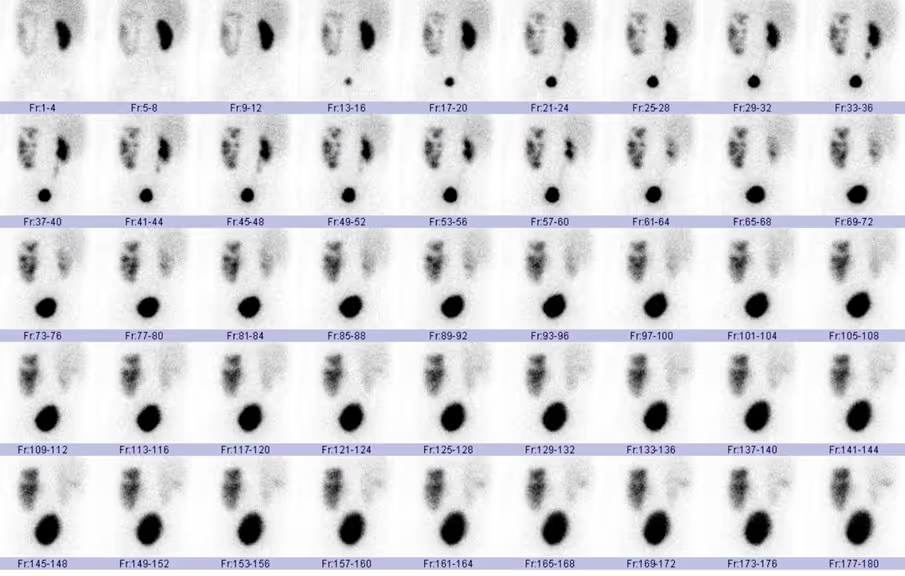 An example of a renal scan in a child
Renal Scan
Uses 99mTc-MAG3 or 99mTc-DTPA to evaluate kidney function, detect urinary obstruction, and monitor kidney function after transplantation. Suitable for both children and adults.
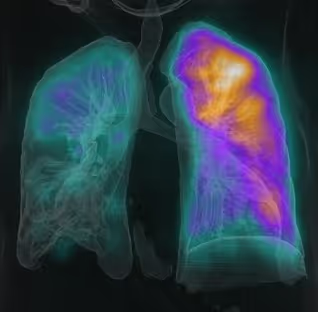
Lung perfusion scan
Lung Perfusion Scan
Uses 99mTc-MAA to assess blood flow in the lungs. This test helps diagnose conditions such as pulmonary embolism (PE) and chronic lung diseases like chronic obstructive pulmonary disease (COPD).
Thyroid Scan
Uses 99mTc-pertechnetate to evaluate thyroid function. It helps diagnose hyperthyroidism, hypothyroidism, and thyrotoxicosis by assessing radiotracer uptake in the thyroid gland.
Preparation for SPECT CT
- Eating and drinking are permitted prior to the examination.
- Remove all jewelry before the examination.
- Those who have a history of allergies to iodine or radiopharmaceuticals should inform the doctor in advance.
- Those who take personalized medications or supplements should inform the doctor in advance.
- Those who have a history of accidents, broken bones, fractures, or wear prosthetic organs should inform the doctor in advance.
Post SPECT CT instructions
- Drink 1-1.5 liters of water 2-3 days after the examination to flush out the radioactive tracer from the body.
- Wash your hands thoroughly after using the toilet.
- Avoid close contact with young children and pregnant women for 24 hours.
- Normal activities can resume as usual.
Who should not undergo SPECT CT?
- Pregnant women
- Breastfeeding women
- Thyroid hyperplasia associated with thyroid cancer
What are the side effects of SPECT CT?
The amount of radiopharmaceutical used depends on the patient’s body weight and has a very short half-life. As a result, SPECT/CT is a highly safe procedure, and the radiotracer does not remain in the body.
What are the benefits of SPECT CT?
- Accurate interpretation: SPECT CT can detect abnormalities in organs and body systems that other diagnostic imaging tests, such as CT, cannot. This enables nuclear radiologists to correctly interpret and diagnose diseases, resulting in an accurate, personalized treatment plan. This enables radiologists to correctly interpret and diagnose diseases, resulting in an accurate, personalized treatment plan.
- Minimally invasive: SPECT CT is a minimally invasive procedure involving the injection of a radioactive tracer into the body prior to the examination. There is no large surgical incision, and neither local anesthesia nor sedation is used. The examination is less painful, safe, and free of serious complications or side effects.
- Personalized treatment plan: SPECT CT provides clear and specific diagnostic results, allowing doctors to plan a personalized treatment plan, leading to effective and timely treatment.
- No overnight hospitalization: SPECT CT is an outpatient procedure; there is no need for an overnight hospital stay. The entire examination process takes half a day. The examinee can return home and resume normal daily activities as usual.
- Low-dose radiation: Unlike other diagnostic imaging exams, SPECT CT uses a lower radioactive tracer dose, typically the same amount of X-ray radiation used in general physical examinations, such as chest X-rays, making it a safe diagnostic imaging exam without causing any harm to the examinees.
How long does it take to get SPECT CT results?
Typically, after a SPECT CT procedure, the radiologist will take 2-3 days to a week to interpret the results before informing the examinee. The physician will use the results to plan a personalized treatment plan suitable for each patient.
SPECT CT, MedPark Hospital
Diagnostic Radiology Center at MedPark Hospital, Bangkok, Thailand, is supervised by seasoned teaching faculty radiologists, including radiation oncologists, intervention radiologists, and nucleologists (nuclear medicine physicians) with extensive experience both nationally and internationally, ready to provide seamless diagnostics for common conditions and high-acuity conditions using state-of-the-art digital medical instruments, including Digital X-ray, PET CT, or SPECT CT, and other leading-edge medical equipment to ensure accurate diagnosis, fast results, and precise interpretation, leading to effective and systematic treatment integrated with the close collaborative work of a multidisciplinary team of specialists to provide holistic intervention, enabling fast, safe, and consistent treatments, allowing patients to recover quickly, have healthy physical health, and live lives at their best.
FAQ
- What is the difference between SPECT and CT?
SPECT is a nuclear medicine imaging modality involving radioactive tracers emitting gamma-ray energy photons given by injection, swallowing, or inhalation before capturing images to assess the function of the body's organs, tissues, and blood circulation as well as to detect cancer or tumors. SPECT will display the abnormal results as bright areas on the images.
CT, or computed tomography, is detailed imaging of the anatomical bodily structure with X-rays. CT scans reveal the size and location of organs, bones, and tissues while also screening for cancer or tumors. CT will display abnormal results in black and white spots.
Nuclear radiologists combine SPECT and CT images to generate detailed, clear, and accurate diagnostic images of the bodily anatomic structures.